Collagen coffee is one of the most searched wellness products in the US market right now. It is also one of the most misrepresented. The marketing claims range from scientifically grounded to biologically impossible — and most consumers have no framework for telling which is which. Here is the honest science behind what collagen coffee can and cannot do for your skin.
The Claim That Is Actually True
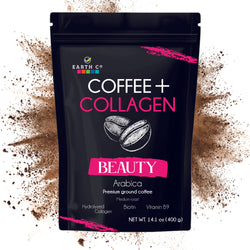
Hydrolyzed collagen peptides — the specific form of collagen that Earth Co uses in BEAUTY Coffee — do survive digestion, enter the bloodstream, and reach skin fibroblasts where they trigger measurable biological responses.
This is not obvious. Native collagen molecules are too large to be absorbed through the intestinal wall. Hydrolyzed collagen has been enzymatically broken into short peptide fragments — typically between 2,000 and 5,000 Daltons — that intestinal tight junctions can transport into circulation. Once in the bloodstream these peptides do two things: they provide the specific amino acids — glycine, proline, hydroxyproline — that fibroblasts need to synthesize new collagen, and they act as signaling molecules that tell fibroblasts collagen breakdown has occurred and that new synthesis is required.
Research published in the Journal of Cosmetic Dermatology examining hydrolyzed collagen supplementation at 2.5 to 10 grams per day found statistically significant improvements in skin elasticity at eight weeks of daily use. A meta-analysis published in the International Journal of Dermatology reviewed 19 randomized controlled trials and concluded that hydrolyzed collagen supplementation produced significant improvements in skin hydration, elasticity, and wrinkle depth relative to placebo. The effect is real, documented, and mechanistically explained.
The Claims That Are Not True
Several claims that appear routinely in collagen coffee marketing have no meaningful biological basis.
Overnight results. Collagen synthesis is a biological process that operates on a timeline of weeks. Fibroblast upregulation, new collagen fiber deposition in the dermis, and the accumulation of those fibers to concentrations that affect the mechanical properties of skin require consistent daily supplementation over four to eight weeks minimum. Any product claiming visible results in days is describing a hydration effect — temporary surface plumping from hyaluronic acid stimulation — not structural collagen improvement.
More collagen means better results. Above approximately 10 grams of hydrolyzed collagen per day, research does not show proportionally greater skin outcomes. The limiting factor is not collagen availability — it is fibroblast receptor signaling capacity and the biological rate of collagen fiber assembly. A product containing 20 grams per serving is not twice as effective as one containing 10 grams. It is more expensive.
Any collagen form works. This is the most commercially exploited misconception in the category. Marine collagen, bovine collagen, and plant-based collagen alternatives are not equivalent. Native collagen — not hydrolyzed — cannot be absorbed through the intestinal wall regardless of source. Collagen from poor-quality sources may have inconsistent peptide size distribution that reduces absorption efficiency. Type selection matters: type I collagen is the structural protein of skin and nails, type III contributes to skin elasticity. Products that do not specify type or hydrolysis method are either uninformed about their formula or prefer that you are.
Why the Coffee Base Matters for Skin Specifically
Coffee is not a neutral vehicle for collagen delivery. Earth Co's organic high-altitude Mexican coffee contributes two skin-relevant effects that complement the collagen component directly.
Coffee polyphenols — particularly chlorogenic acids — are among the most potent dietary antioxidants available. Free radicals generated by UV exposure, pollution, and metabolic activity attack existing collagen fibers and accelerate the structural degradation of the dermis. Daily polyphenol intake from specialty coffee provides meaningful antioxidant protection that reduces this oxidative collagen breakdown — building new collagen through the hydrolyzed peptides while simultaneously protecting the collagen already present.
Caffeine improves microcirculation in the dermis — the vascular network that delivers circulating collagen peptides to the fibroblasts that need to receive the synthesis signal. The caffeine component of BEAUTY Coffee actively supports the delivery of the very peptides the collagen component provides.
What Consistent 30-Day Use Actually Produces
Week one and two: improved skin hydration through hyaluronic acid stimulation. Surface texture begins to improve. Changes are subtle and internal — collagen fiber deposition is occurring in the dermis but not yet at concentrations that produce visible surface changes.
Week three: skin firmness and elasticity begin to noticeably improve. The dermis has accumulated sufficient new collagen fiber density to affect the mechanical properties of skin. Fine lines soften. Skin rebounds more quickly when pressed.
Week four: cumulative improvements in elasticity, hydration, and surface smoothness are clearly visible. Nail strength improves significantly — nails grown during supplementation show better structural integrity. Hair quality improvements become visible in new growth.
The Marketing Test
When evaluating any collagen coffee product, ask three questions. Does it specify hydrolyzed collagen — not native collagen? Does it specify type I and III — not just collagen? Does it provide a dose in the range of 2.5 to 10 grams per serving — the range with documented clinical evidence?
Products that answer all three questions transparently are formulated around the science. Products that do not are formulated around the label.